


My Journey as a SCUBA diver
I decided to share my story of how SCUBA diving has allowed me to go beyond the surface of the ocean to learn and appreciate more about what lies beneath the waves. My journey essentially begins as a college course during graduate school, then to assisting and conducting research on coral reefs. My journey entails a long pause from scuba diving to refreshing my skills and a yearning to dive some more. Onwards, or should I say downwards...


So what is SCUBA?
Self Contained Underwater Breathing Apparatus, or SCUBA is designed to equip human beings with survival apparatus to adapt to specific depths and time underwater. The specific design of the equipment depends on the purpose of the dive: pleasure, research, or work.
SCUBA tanks contained compressed air in the form of 78% nitrogen and 21% oxygen. A common misconception is that the air tanks only consist of oxygen.
I have used Nitrox tanks to scuba dive before, and these tanks contain 32-36% oxygen, which allows you to stay longer underwater.
I have not used Trimix, which are tanks that include helium to the mix of nitrogen and oxygen. I have no desire to conduct underwater welding or some other technical underwater employment.

The Beginning
For me, I was just so curious that there were collegiate courses, such as golf, frisbee golf, archery, and SCUBA diving. As a graduate student, I needed an activity that focused on survival. Honestly, that's what it was for me. What activity requires you to not think about bills, problems, work, or an hour and a half commute to classes? For me it was scuba diving.
I already chose my research on shallow-water coral reefs, which depended on "dry tides" lowest low tides, but I wanted to learn to scuba dive so that one day if an opportunity should present itself, I would be ready!


SCUBA and Research
An opportunity presented itself during graduate school to conduct research on the symbiosis between clownfish and sea anemones in Aqaba, Jordan, northern Red Sea. I spent a year preparing for this trip. In fact, I had to practice my research methods at Auburn University's pool during a SCUBA class. I used a mirror purchased from Walmart and etched centimeter marks on the boarders. I was able to use this non-intrusive method to accurately measure clownfish while in their sea anemones (see Clownfish Publication).
Each day, for a period of 3 weeks I was able to SCUBA dive twice a day to conduct research in pristine clear water, which is something I will never forget. Over 60 dives in the Red Sea.
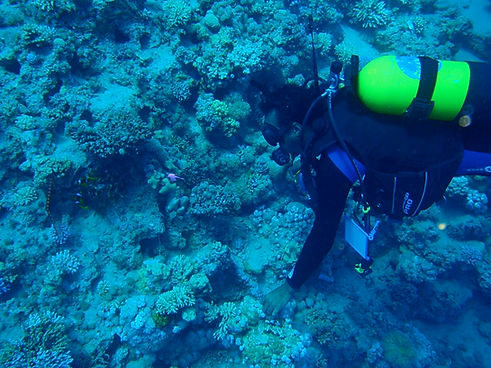
SCUBA Dive #100
Celebrating 100 dives was never on my mind when I started. From diving in the Red Sea and Key Largo, Florida conducting research, to a long pause. Too nervous to even start or complete 3 dives if not for the dive instructors at Crucian Adventure Divers and the BIMS Immersion Program. Coral reef restoration dive initiated a yearning towards the future. Until then, to be continued …


Dive Buddy
A good dive buddy discusses the dive plan before you proceed. This includes underwater signals, an agreement of where the dive is taking place, an agreeable return time, and equipment check. A good dive buddy is someone you know you can depend on if something occurs with equipment while diving, is calm, and can trouble-shoot with effectiveness. Additionally, a great dive buddy will become your lifelong friend, and may even give you a nickname: Flying Fish.
Feature Dive Buddy: Semir Koklu
Dive Site: Aqaba, Jordan
Research: Clownfish and Sea anemones